EN
EN  DE
DE  ES
ES  FR
FR  PT
PT  RU
RU 
You use shell mould casting services and investment casting services for parts that need to be very exact. These methods help you make pieces with hard shapes. They are used in car, plane, and machine industries. The parts must meet tough rules. The casting market is now $23.01 billion in 2024. It will keep growing in the future.
Year | Market Size (USD Billion) |
|---|---|
2024 | 23.01 |
2032 | 31.38 |
KEMING uses new technology and good quality for every investment casting service. This helps you get the results you want.
Key Takeaways
Investment casting gives very accurate shapes and smooth surfaces. This makes it good for making hard metal parts. – Shell casting is cheaper and uses sand and resin molds. It gives good accuracy and a nice look. – Both ways help make parts with tricky shapes. But investment casting gives closer fits and smoother surfaces. – KEMING uses new technology and careful checks. This helps make sure both casting ways work well. – Picking investment casting can save materials and money. It also gives strong and detailed parts for many industries.
Investment Casting Overview
What Is Investment Casting?
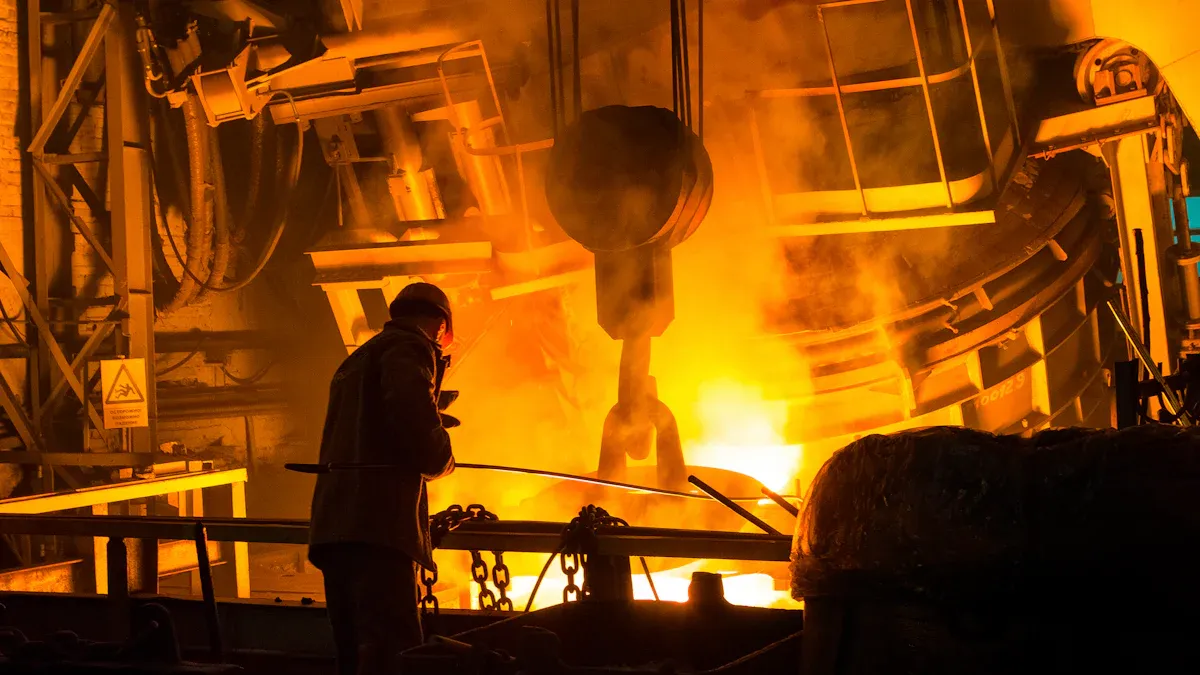
Investment casting helps you make metal parts with tiny details. The surfaces of these parts are very smooth. This process lets you create shapes that are hard to make in other ways. Experts say investment casting is a precise way to cast metal. You can make complicated metal parts that are very accurate. The surfaces look nice and smooth. If you need parts with small features or exact sizes, investment casting is a good choice. First, you make a pattern from wax or plastic. The pattern looks like the final part. Next, you cover the pattern with ceramic layers. This makes a strong shell. You remove the wax from inside the shell. Then, you pour hot metal into the shell. When the metal cools, you break the shell. The finished part is inside.
Shell Casting Basics
Shell casting is another way to make metal parts. It gives you good accuracy and a nice finish. You use sand mixed with resin to make a mold around a pattern. This method gives you smooth surfaces and lets you make detailed designs. Shell casting is special because it saves work and money. It also gives great wear and heat resistance. Here is a table that shows how shell casting compares to other ways:
Characteristic | Shell Mold Casting | Other Casting Methods |
|---|---|---|
Surface Finish | High-quality finish | Varies |
Dimensional Accuracy | High | Lower |
Complexity of Designs | Intricate designs | Limited |
Labor and Cost Efficiency | Reduced | Higher |
Wear and Heat Resistance | Excellent | Varies |
How They Relate
Both investment casting and shell casting help you make parts with tricky shapes. The surfaces are smooth. You use patterns to shape the parts in both methods. Investment casting uses wax or plastic patterns and builds ceramic shells. Shell casting uses sand and resin molds. Investment casting gives tighter sizes and smoother surfaces. Shell casting makes molds faster and costs less for big batches. Here is a quick table to compare their steps:
Aspect | Investment Casting | Shell Mould Casting |
|---|---|---|
Pattern Creation | Uses detailed wax or plastic patterns that match the final part. | Uses a two-part mold made from sand and resin. |
Mould Formation | Ceramic layers are added to make a strong shell. | A pattern shapes the part inside the mold. |
Wax Removal | Wax is melted out to make a hollow shell. | Not needed; the mold is made from sand and resin. |
Metal Pouring | Hot metal is poured into the ceramic shell. | Hot metal is poured into the mold. |
Final Product | The shell is broken after cooling to show the finished part. | The mold is removed after the metal hardens, leaving a precise part. |
KEMING uses both casting methods to help you get great results for your project.
Investment Casting Process Steps
Pattern Creation
You begin by making a pattern for the part. This pattern matches the final part exactly. Most patterns use wax because it melts and can be reused. Sometimes, aluminum alloy, steel, or titanium alloy is used for special jobs. Each material has its own good points. Wax is easy to shape and recycle. Aluminum alloy is strong for car and machine parts. Steel is tough and lasts long. Titanium alloy is light and strong, good for golf clubs and marine tools.
Material | Advantages |
|---|---|
Wax Patterns | You can melt and reuse wax for new patterns. |
Aluminum Alloy | It is strong for cars, electronics, and machines. |
Steel | Steel is tough and used in many auto parts. |
Titanium Alloy | It is strong and does not break easily, great for golf clubs and marine parts. |
Investment Casting | You can make hard shapes, tight sizes (up to .003″), and smooth surfaces. |
KEMING uses special wax machines to make sure patterns are exact. You get patterns with tight sizes and smooth surfaces. This step is important because it sets the part’s shape.
Pattern Assembly
After making patterns, you put them on a central sprue. It looks like a tree with patterns as branches. You pick wax that shrinks little and flows well. The wax fills the mold so there are no mistakes. You attach each pattern to the sprue carefully. The gating design helps metal flow later.
Technique | Description |
|---|---|
Wax Material Selection | Pick wax that shrinks little, flows well, and burns clean. |
Wax Injection Process | Use exact settings so wax fills every space and stops mistakes. |
Pattern Assembly (Tree Building) | Attach patterns to the sprue the right way for good casting. |
Gating Design | Good gating lets metal flow well and stops mistakes. |
Watch out for common problems:
Shrinkage: Metal cools too fast.
Porosity: Gas gets trapped inside.
Misruns: Metal does not fill the mold.
Cold shuts: Metal does not join together.
Inclusions: Ceramic or dirt gets in the casting.
KEMING checks every pattern assembly to stop these problems. This helps you get good parts from investment casting.
Shell Building
You dip the wax tree into ceramic slurry. The slurry has tiny ceramic pieces and a binder. Sprinkle fine sand or stucco on the wet tree. This makes the shell stronger. Let the shell dry, then repeat dipping and sprinkling many times. Each layer makes the shell thicker and stronger.
Dip the wax tree in ceramic slurry.
Sprinkle sand or stucco on the wet tree.
Let the shell dry.
Repeat to build a thick shell.
The ceramic shell shapes the hot metal during casting. You get parts with smooth finishes and hard shapes. KEMING checks shell thickness carefully. If the shell is too thick, cooling is slow and stress can happen. If the shell is uneven, it can crack or bend. Even shell thickness is important for precise casting.
Evidence Description | Impact on Casting Quality |
|---|---|
Different shell thickness changes heat transfer | This affects size and surface quality |
Thick shells slow cooling | This causes stress and bending |
Shell bends from heat | This can break or bend the shell |
Uneven shell thickness | This causes cracks from stress |
Keeping shell thickness even | This helps keep the part’s size right |
Wax Removal
You take out the wax from the ceramic shell using special ways. Steam autoclave dewaxing uses steam to melt wax fast. This works for hard shapes and thin shells. Flash-fire dewaxing uses fire to burn out wax quickly. This is best for strong shells.
Steam autoclave dewaxing melts wax with steam.
Flash-fire dewaxing burns wax with high heat.
KEMING picks the best way for your part. This step leaves a hollow shell ready for the next step.
Shell Preheating
You heat the ceramic shell before pouring metal. This step dries the shell and removes ash. It gets the shell ready for hot metal. Preheating stops shock when you pour metal in.
The shell molds are heated to 1500 °C to stop thermal shock during casting.
Shell preheating helps metal fill every part of the mold. If you heat the shell too much, you can get gas holes or rough surfaces. KEMING controls the heat for the best results.
Shell preheating also makes the metal better. You get good filling and smooth surfaces.
Metal Pouring
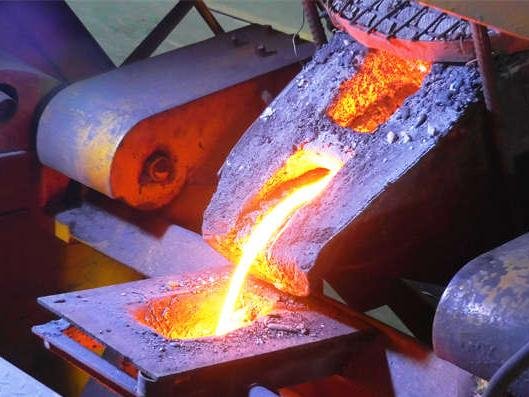
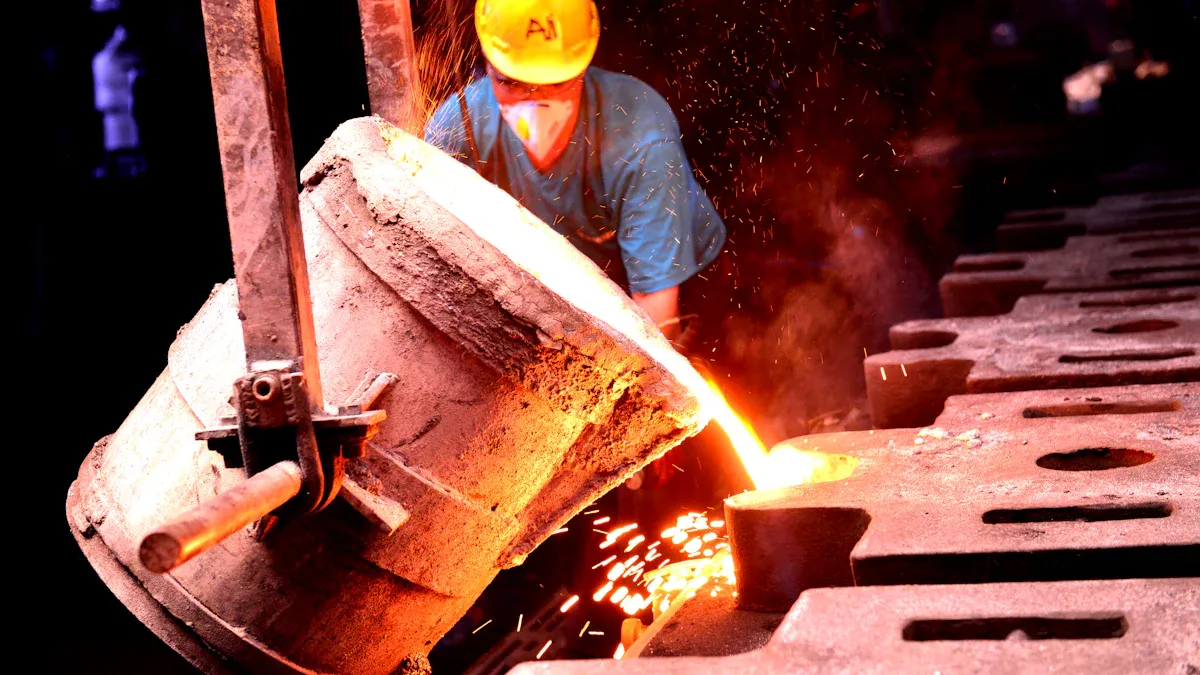
You pour hot metal into the heated shell. Many metals can be used in investment casting. These include steel alloys, stainless steel, cobalt base alloys, nickel base alloys, super alloys, copper base alloys, cast iron, aluminum, and titanium.
Steel alloys
Stainless steel
Cobalt base alloys
Nickel base alloys
Super alloys
Copper base alloys
Cast iron
Aluminum
Titanium
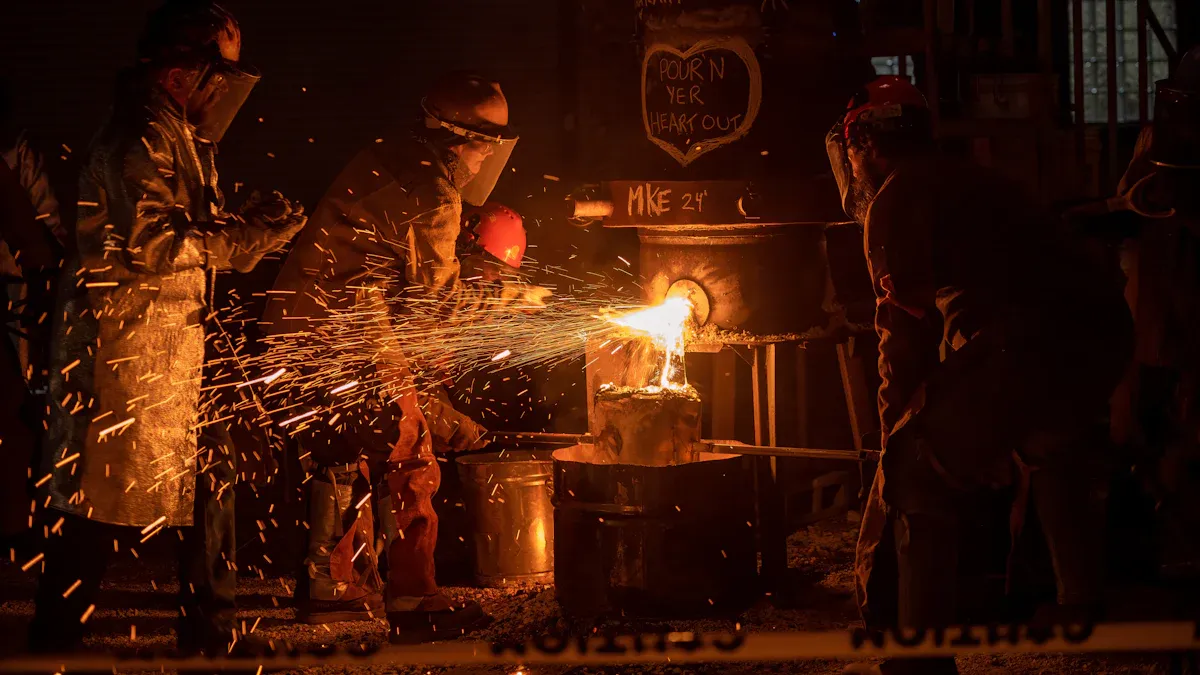
KEMING gives you many metal choices for your project. The casting process uses safety rules to keep workers safe and make good parts.
Safety Protocols | Description |
|---|---|
Personal Protective Equipment (PPE) | Wear gloves, boots, and covers to stay safe. |
Proper Machine Handling | Check machines and keep the area neat to stop accidents. |
Moisture Control in Molds | Make sure molds are dry and heated to stop steam blasts. |
Adequate Ventilation | Use fans and filters to keep air clean. |
Cooling and Shell Removal
After pouring, let the metal cool and get hard in the shell. Remove the ceramic shell using vibration, water jets, sandblasting, or hammering. These ways can leave bits or dirt, so you may need extra cleaning.
Vibration
Water jetting
Sandblasting
Hammering
You can also use caustic leaching to clean out ceramic bits. This is good for small spaces and inside channels. KEMING uses these ways to make sure your part is clean.
Finishing
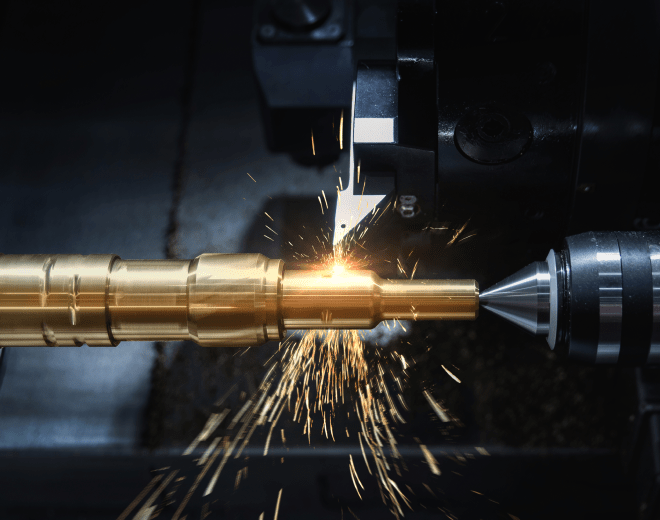
The last step is finishing the part. You polish it to make it shiny. Electropolishing makes the surface even cleaner. You can add coatings or plating for extra protection. Surface treatments help make the texture even.
Polishing
Electropolishing
Coating
Plating
Surface treatments
Investment casting gives you tight sizes and smooth surfaces. You can see the usual sizes in the table below.
Tolerance Category | Linear Dimension Tolerance (ISO8062) |
|---|---|
CT4 | ±0.13 |
CT5 | ±0.18 |
CT6 | ±0.26 |
CT7 | ±0.37 |
CT8 | ±0.5 |
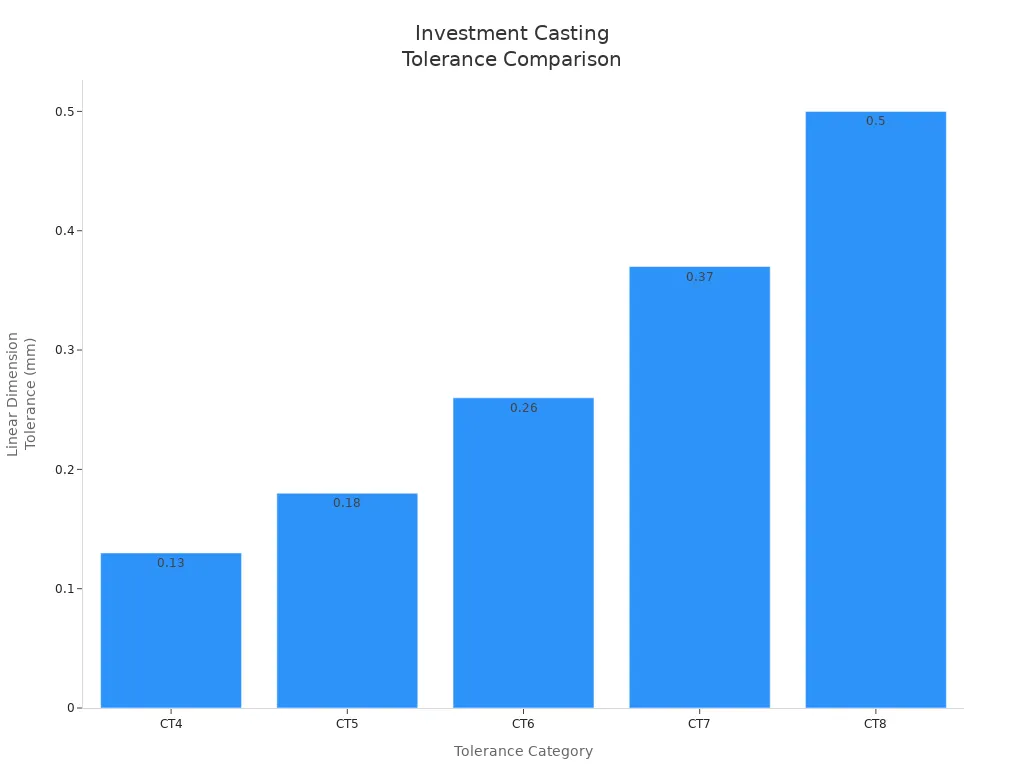
You also check flatness, straightness, and roundness. KEMING uses new technology and strict checks to make sure every part is right. Investment casting gives you parts with smooth surfaces and exact sizes.
Investment Casting Advantages
Key Benefits
You get many good things when you pick investment casting. This process is special because it gives you:
High precision and accuracy for each part.
You can make complex shapes and thin walls easily.
You have many material choices like stainless steel, superalloys, and aluminum.
The surface finish is excellent, so you need less polishing.
Tooling costs are lower, which helps with small batches.
There are fewer defects than sand casting, so parts are more reliable.
Near net-shape results mean less waste and you save material.
Investment casting lets you use both ferrous and non-ferrous metals. You can make parts with fine details and tight tolerances. This process also helps you use less labor and material, so your work is more efficient and eco-friendly.
Here is a table that shows how investment casting compares to other casting methods for surface finish:
Casting Method | Surface Roughness (Ra) |
|---|---|
Investment Casting | 0.6–0.9 µm |
Sand Casting | 6–12 µm |
Die Casting | 1.6–3.2 µm |
You see that investment casting gives the smoothest surfaces. This means your parts look and work better right away.
Typical Applications
You find investment casting in many industries that need strong and complex parts. KEMING works with these fields:
Aerospace: You use investment casting for turbine blades, fuel nozzles, brackets, and landing gear parts. These parts must be safe and work well.
Automotive: You use this process for engine parts, transmission pieces, and custom brackets. Investment casting helps make car parts lighter and stronger.
Machinery: You pick investment casting for gears, housings, valves, and pump parts. The process makes detailed designs and uses tough materials.
Medical and Food Processing: You need clean, smooth, and strong parts. Investment casting gives you stainless steel parts that meet hygiene rules.
Energy and Marine: You use this method for valves, impellers, and fittings that resist heat and corrosion.
Investment casting lets you design parts with thru-holes, slots, and other features that are hard to make with other casting methods. You get to create what you need, even if it is very complex.
KEMING uses advanced technology and strict checks. You can trust your parts to meet high standards in any industry.
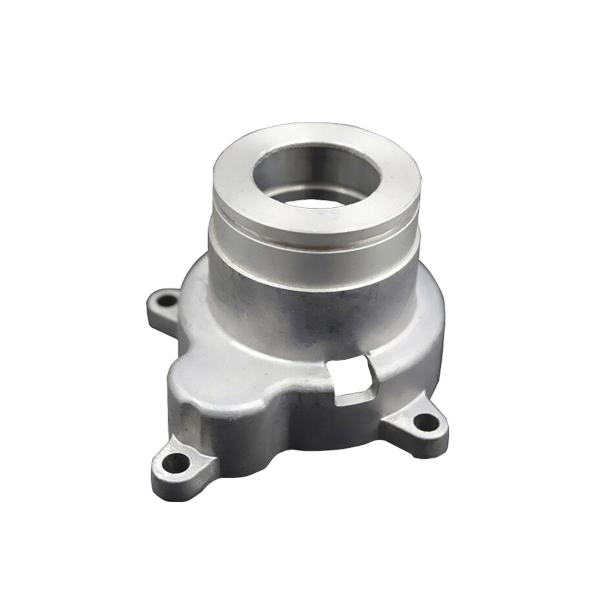
You can count on investment casting for making metal parts. This process is very exact and works with many alloys. It helps you make parts with hard shapes and smooth surfaces. You use less material and spend less money. Many companies use casting for turbine blades, medical tools, and machine parts. KEMING uses new technology and careful checks to give you good results. Try investment casting for your next project and notice better quality.
Less material is wasted and costs are lower
Parts have tight sizes and tricky shapes
Used in planes, hospitals, and factories
FAQ
What is the main difference between shell and investment casting?
Shell casting is quick and saves money. It uses sand and resin molds. Investment casting is better for smooth and exact parts. It uses wax patterns and ceramic shells.
Which metals can you use in investment casting?
You can pick from many metals. These include stainless steel, carbon steel, aluminum, copper alloys, and superalloys. This lets you choose the best metal for your needs.
How accurate are investment cast parts?
Investment casting makes parts with tight sizes. Most parts are as close as ±0.13 mm. This helps you make detailed and strong pieces.
Why should you choose KEMING for investment casting?
KEMING uses new technology and checks quality closely. You get many metal choices. KEMING helps you from start to finish. You always get exact and good parts.