EN
EN  DE
DE  ES
ES  FR
FR  PT
PT  RU
RU 
Lost-wax casting (also known as *cire-perdue*) is a precision jewelry-making technique. Artisans begin by encasing a wax model in a mold, then applying heat to melt and drain the wax, leaving behind a cavity that perfectly mirrors the original shape. Molten metal is subsequently poured into this void, resulting in a highly precise finished piece. Favored by designers for its ability to capture intricate details often difficult to achieve with other methods, this technique is frequently employed in the creation of custom and structurally complex jewelry. While the process has a long history, modern tools have revitalized it; today, the integration of 3D printing technology with this ancient craft opens up limitless possibilities. This blend of the old and the new makes lost-wax casting a fascinating field to explore.
Key Takeaways
- Lost wax casting makes detailed jewelry by melting a wax model and pouring metal into the mold.
- The process has seven steps, and each one matters for a good final piece.
- Different wax types work best for different designs, so pick the right one for your project.
- Modern 3D printing and CAD software make lost wax casting simpler and more imaginative.
- This method works with gold, silver, and bronze, offering many metal options.
Lost-Wax Casting Process
The lost-wax casting process consists of seven distinct steps. Each step depends on the one before it; a single mistake could send you back to square one. Understanding this sequence helps jewelers plan ahead and avoid costly errors.
Creating the Wax Model
The process begins with a wax model. Artisans can carve the wax by hand using heated blades, spatulas, and needles. They roll and shape the wax on a wooden block to form the basic structure before adding intricate details. Some jewelers attach thin, hollow wax rods to create channels for the molten metal later in the process.
The type of wax matters. Different waxes possess specific properties suited to various jewelry applications. The table below lists commonly used options:
| Wax Type | Key Characteristics | Best Application |
|---|---|---|
| Green Wax | Hard, stable, smooth finish | Intricate designs, sharp edges |
| Blue Wax | Medium hardness, flexible | Curved designs, rings, pendants |
| Purple Wax | Balanced hardness and flexibility | Detailed designs, clean lines |
| Red Wax | Strong, versatile, soft texture | Designs needing structural integrity |
| Turquoise Wax | Flexible, smooth finish | Organic shapes, flowing designs |
| Pink Wax | Very soft, pliable | Fine details, prototyping |
| Sheet Wax | Flat, pliable | Layered designs, modelling |
| Beeswax | Soft, malleable | Organic, flowing designs |
Jewelers often mix wax types in one piece. Different melting points don’t cause issues because the burnout temperatures are so high that these differences don’t matter.
Design rules help ensure success. Wall thickness should stay even, with a minimum of 0.8 mm for silver or bronze and 0.6 mm for gold. Bridges and connectors need at least 1.0–1.2 mm. The sprue should attach at the thickest point so metal flows into thinner areas. Smoother wax models reduce cleanup after casting, and engravings should sit deeper than needed to survive finishing.
Mold Making and Dewaxing
Once the wax model is complete, the jeweler attaches a sprue. Resembling a tree branch, the sprue connects the workpiece to a central “wax tree.” The assembly is then placed inside a casting flask, and investment material—typically a gypsum-based refractory compound—is poured around it. This material sets and hardens, forming a solid casting mold.
Investment molds are created using silica-based materials. Artisans dip the wax model into a silica slurry and coat it with refractory sand (such as graded crystalline silica sand) to build up a refractory shell. After the investment material sets, the flask is placed in a kiln for the dewaxing process. This step gives the technique its name: the wax melts and flows away at high temperatures, effectively becoming “lost.” High heat also further hardens the investment material and drives out moisture; the steam generated from the damp gypsum helps expel the molten wax, thereby minimizing carbonized residue within the mold.
The peak temperature during dewaxing is sufficient to completely remove the wax, while the duration of the heat soak depends on the flask’s size and airflow conditions. Within this temperature range, carbon residues are fully eliminated.
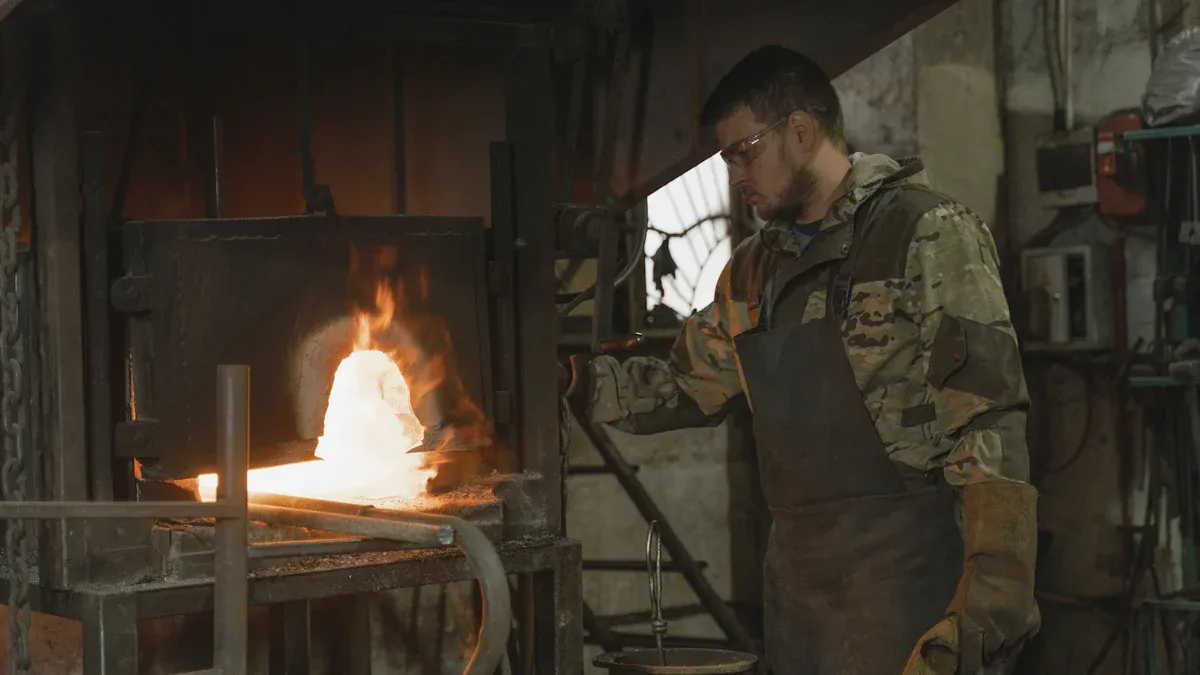
Safety is paramount during dewaxing and casting. Heating wax can produce toxic fumes, necessitating the use of local exhaust ventilation. Risks include potential burns when inspecting flasks and the possibility of the investment material cracking or bursting due to heat. Consequently, wearing protective gloves and safety goggles, as well as using non-slip tongs, is essential. Opening the kiln door before wax residues have completely burned off can trigger a flare-up; therefore, jewelers typically keep the door closed to suppress flames.
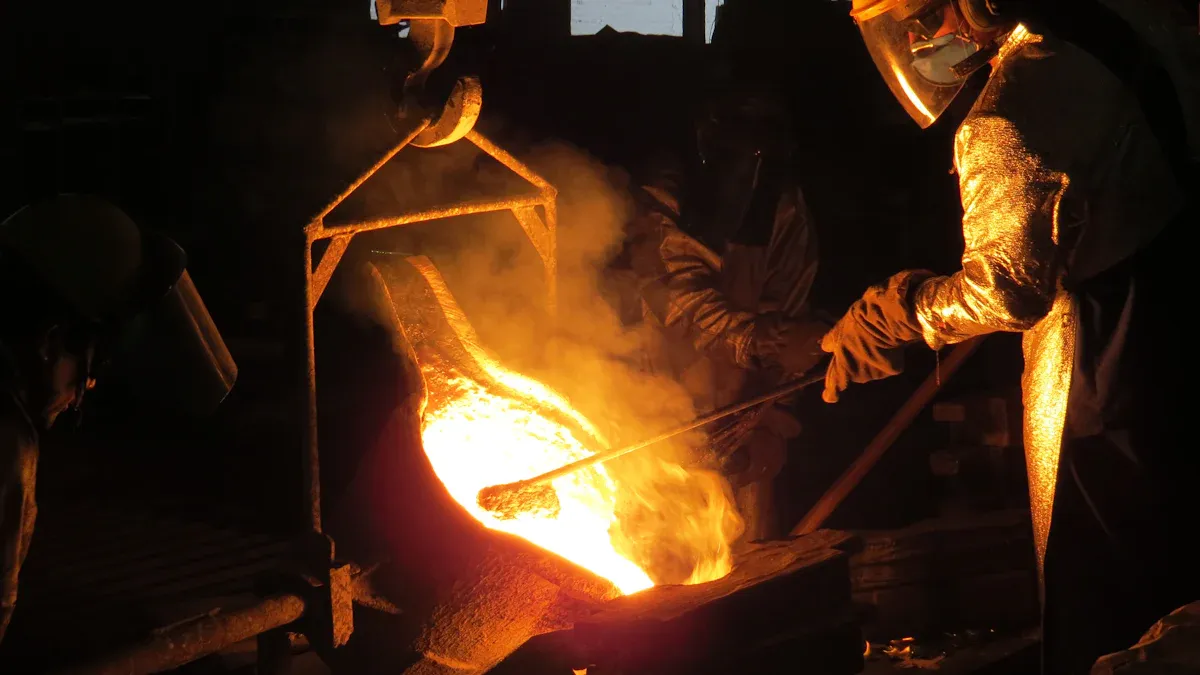
Once dewaxing is complete, the mold is ready to receive molten metal. The jeweler pours the hot liquid metal into the cavity, filling every detail previously occupied by the wax model. This method is suitable for casting gold, silver, bronze, and other metals. After cooling, the jeweler breaks away the investment material and cuts the workpiece from the metal tree, leaving a sprue stub that will be removed during subsequent finishing. This process is suitable for both hobbyists and professionals. Beginners can start by sending their wax models to a local casting service, where experts handle the molding and casting stages. The lost-wax casting method requires patience and precision, transforming simple wax sculptures into durable pieces of jewelry.
A Brief History of Lost Wax Casting
The lost-wax casting method has a long history. Artisans have used this technique for thousands of years. The earliest known artifacts, from the Nahal Mishmar region, date to approximately 4500–3500 BCE. This finding shows the technique’s origins in the fourth millennium BC.
Ancient Origins and Evolution
This craft was widely practiced across many ancient civilizations. Around 3500 BCE, the “Dancing Girl” figurine appeared in Mohenjo-daro in the Indus Valley. Copper objects were produced in Mesopotamia as early as the Chalcolithic period. Ancient China employed the lost-wax method to cast ritual bronze vessels. Greek artisans created the famous Riace Bronzes, while the Etruscans and Romans adopted Greek techniques for large-scale production. Royal bronzes emerged in West African cultures, and pre-Columbian American civilizations crafted gold and silver masks.
| Region | Time Period | Key Example |
|---|---|---|
| Indus Valley | ~3500 BCE | ‘Dancing Girl’ of Mohenjo-Daro |
| Mesopotamia | 4500–3500 BCE | Nahal Mishmar copper artifacts |
| Ancient China | 1600–256 BCE | Ritual bronzes |
| Ancient Greece | Classical period | Riace Bronzes |
| Etruscans & Romans | Antiquity | Mass-produced statues |
| West Africa | 12th century onwards | Royal bronzes |
| Pre-Columbian Americas | Pre-Columbian era | Gold and silver masks |
Why It Remains Significant Today
The core principles of lost-wax casting have remained unchanged, even as evolving tools and materials have made the process easier to apply. Modern goldsmiths and jewelry makers continue to use this technique for several key reasons.
The process delivers exceptional surface quality. Fine investment materials (mold materials) capture textures and details that are difficult to achieve with other methods, which is crucial for creating smooth, lustrous jewelry surfaces. Furthermore, the process is compatible with a wide range of metals—including gold, silver, bronze, and brass—yielding excellent casting results.
Design flexibility is another major advantage. Lost-wax casting enables the creation of complex internal structures and undercuts—features that are unattainable with other casting methods. It supports intricate jewelry designs and is suitable for both bespoke pieces and mass production.
The technique remains highly cost-effective. By using a “wax tree” structure, dozens of pieces can be cast in a single pour, effectively reducing metal waste and labor costs. The fixed mold geometry ensures consistent dimensions across all finished products. Additionally, modern digital tools integrate seamlessly with the process; CAD modeling and 3D-printed wax patterns successfully combine traditional craftsmanship with modern technology.
Modern Innovations in Lost-Wax Casting
The Role of 3D Printing and CAD
Digital tools have changed how jewelers do lost-wax casting. CAD software lets makers create complex designs on a screen. A maker can spin, zoom, and change every angle before making a real model. This process removes much of the guessing that comes with hand carving.
The process has two clear steps. First, the maker sends the CAD file to a high-precision 3D printer. The printer makes a physical wax model without any hand carving. This wax model then becomes the pattern that is lost in the traditional lost-wax casting process. Heat melts away the wax to make the mold for the final metal piece. This mix of 3D-printed wax patterns and traditional casting sparks new ideas in jewelry making. Designers can try many versions quickly before deciding on one for production.
Small businesses get a lot of help from this technology. Easy-to-use 3D printing setups allow high-volume production without needing more workers. In the old process, makers had to make a wax mold for each item. That took much more hand work. One creator said, “We used to have to say no to fun and crazy requests, which was really annoying. Now it’s no problem. We never have to say no anymore.”
Lost Wax Casting for Jewelry: Pros and Cons
Lost-wax casting has clear pros and cons for jewelry makers. The table below shows the main trade-offs:
| Aspect | Advantage | Disadvantage |
|---|---|---|
| Design Complexity | Allows detailed patterns and fine textures needed for fancy pieces. | The many steps need skilled workers and careful handling. |
| Accuracy & Finish | Gives very accurate size (±0.1 mm) and a smooth surface, cutting down on polishing. | The hard mold-making process takes more time and money than simpler methods. |
| Material Use | Works with gold, silver, and bronze, giving choice in metal. | Only for small to medium sizes, which may limit bigger parts. |
| Production Volume | Best for low-volume, custom, or unique pieces. | Not as good for high-volume mass production because each piece takes a lot of time. |
This method keeps very tight tolerances and very smooth surfaces that are important for fine jewelry. It removes most machining steps and works with all metals from low to high melting points, including precious metals. But the process has many complex steps that make it more expensive than other methods. Costly patterning dies and special refractory materials add to the cost. The many steps need skilled workers and careful handling at each stage.
Investment casting gets tight tolerances and very good surface finish compared to other methods. Sand casting, for example, gives rougher finishes and lower accuracy. The ceramic shell mold in investment casting allows smooth surfaces and tight tolerances that sand casting cannot match. For complex shapes, thin walls, and fine details, this method is still the best choice. The results are very consistent across production runs, with few tool changes needed.
The mix of traditional skill and modern digital tools makes this method easier to use than ever. Businesses can now make custom pieces with fine detail without the very high costs of the past.
The lost-wax casting process has evolved from ancient workshops to modern studios. While its core principles remain unchanged, the introduction of digital tools has vastly expanded its scope of application. Designers now combine hand-carved wax models with 3D-printed ones, unlocking entirely new creative possibilities. This fusion of tradition and technology has made the craft accessible to everyone.
Hobbyists can simply send their wax models to a casting service to obtain professional-grade finished pieces, while businesses can leverage precision casting services that offer rigorous quality control. Thanks to its exceptional accuracy and versatility, lost-wax casting remains a cornerstone of jewelry making.
Although the wax melts away during the process, it leaves behind an enduring masterpiece. Every finished piece begins as a humble wax model; it is this transformative process that turns a creative concept into a treasured gem.
FAQ
What types of wax work best for jewelry casting?
Green wax gives sharp details. Blue wax fits curved rings and pendants. Purple wax balances detail with flexibility. Each type helps with different jewelry design needs.
Can beginners try lost-wax casting at home?
Beginners can send wax models to casting services. Experts handle the mold and pouring steps. This way, newcomers learn without buying costly equipment.
What metals work with this casting method?
Gold, silver, bronze, and brass all work well. The method captures fine details in each metal. This flexibility makes it popular for custom jewelry pieces.
How does 3D printing improve the lost-wax process?
3D printing makes wax patterns from digital design files. This step removes the need for hand carving. Designers can try many versions quickly before picking one for production.